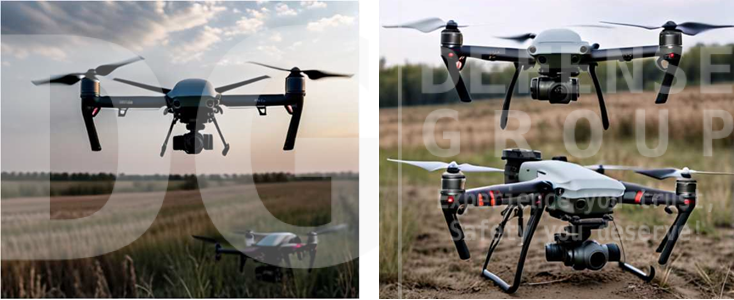
DEFENSE GROUP INSIGHT
A heavy bomber drone enters the enemy rear, delivers an unmanned ground vehicle to carry out a combat mission on the ground — and returns. This is not a film scenario or an exhibition demonstration. It is what Ukrainian forces say happened during Operation Vivaldi in northern Donetsk Oblast.
According to Ukraine’s Third Army Corps, heavy unmanned aircraft delivered kamikaze UGVs more than 10 kilometres behind Russian lines. Ukrainian forces described it as the first operation of its kind, using aerial delivery to deploy ground robotic systems into the enemy rear.
The significance goes beyond a new tactical manoeuvre. It demonstrates how the role of the drone itself is changing.
A modern unmanned aircraft can serve as a weapon carrier, sensor, reconnaissance asset, relay, strike platform, interceptor, electronic-warfare node, carrier for another robotic vehicle, or part of a much larger network.
That shift is changing the economics of warfare, battlefield tactics, air defence, logistics, military training and even the way defence companies develop new equipment.
In 2026, this is no longer a forecast. It is happening now.
FROM THE “FLYING BOMB ” TO THE COMBAT SYSTEM
The concept of an unmanned aircraft is considerably older than today’s drone industry. Experiments with remotely controlled aircraft began during the First World War. In 1917, British engineer Archibald Low tested the radio-controlled Aerial Target. Around the same period, the United States was developing the Kettering Bug, designed to deliver an explosive payload to a designated area, although it never reached operational combat use.
The Second World War brought further unmanned-aircraft concepts. But the technological foundation of today’s UAVs emerged much later, driven by satellite navigation, digital communications, compact cameras, thermal imaging, high-density batteries, advanced electronics and the miniaturisation of computing.
The result was not simply a smaller aircraft without a pilot. It was the emergence of a new class of military capability — one that could collect information, communicate, navigate, carry a payload and increasingly interact with other systems.
THE DRONE BECOMES A NETWORK NODE
Today’s battlespace includes reconnaissance UAVs, FPV and strike drones, heavy bombers, interceptor aircraft, fibre-optic-controlled UAVs, unmanned ground vehicles, maritime unmanned platforms, electronic-warfare systems and automated data-processing technologies.
A reconnaissance aircraft can detect a target and transmit its coordinates to a command-and-control system. Another unmanned asset or artillery unit can then receive the targeting data and engage. This creates a sensor-to-shooter chain.
The shorter that cycle becomes, the less time the target has to detect the threat, react and reposition.
Research in 2026 increasingly describes this direction as warfare at machine speed — an operating environment in which autonomous and remotely controlled systems, battlefield data and human command are becoming connected through increasingly rapid kill chains.
Operation Vivaldi provides a particularly clear battlefield example.
During the offensive, Ukrainian assault units used UAVs and ground robotic vehicles ahead of infantry. The unmanned assets were intended to reduce exposure of personnel during the clearance of enemy positions, while aerial systems simultaneously engaged or supported strikes against command posts, communications nodes, logistics, crossings and reserves.
During the second phase, ground robotic vehicles were delivered by air into the enemy rear. But the aerial deployment of UGVs was only one element of the wider concept. Ukrainian forces also employed air-defence and electronic-warfare capabilities to limit the adversary’s ability to detect the movement of assault groups and identify the direction of the manoeuvre.
This type of integrated employment helps explain why unmanned technologies are moving into the core training and operational concepts of regular armed forces.
A notable example came during Aurora 2026 in Sweden. More than 18,000 personnel from 13 countries took part in the exercise, where Ukrainian operators used reconnaissance and strike drones to examine how NATO units could operate in an environment saturated with unmanned systems.
CHEAPER. MORE NUMEROUS. FASTER
Another major shift is the rise of attritable systems — unmanned military platforms designed so that their loss in combat can be operationally and economically acceptable.
This represents a fundamentally different logic from traditional military aviation.
When a system is substantially cheaper to produce and deploy, quantity itself becomes a combat advantage. Instead of protecting a small number of highly expensive platforms at all costs, forces can generate effects through numbers, replacement capacity and rapid iteration.
This approach has become particularly visible in the war between Russia and Ukraine, but its implications extend well beyond that conflict.
In 2026, the U.S. Army launched its Unmanned Aircraft Systems Marketplace, a digital procurement platform designed to help military units identify, compare and acquire vetted unmanned systems more rapidly.
The United Kingdom has also announced more than £5 billion in investment over the next four years to transform its military drone capabilities.
The change, therefore, is not limited to battlefield tactics. The acquisition model itself is changing.
THE C-UAS ARCHITECTURE
As the number of unmanned aircraft on the battlefield increases, the ability to detect and defeat them becomes equally critical.
This is driving demand for electronic-warfare capabilities, electro-optical and infrared sensors, RF detection, kinetic interceptors, lasers and other directed-energy technologies.
The emerging approach is increasingly architectural rather than platform-specific: detection, identification, tracking, command and control and defeat mechanisms need to work together.
NATO is testing these elements as part of an increasingly integrated C-UAS approach.
During the Technical Interoperability Exercise 2026 in the Netherlands, more than 300 participants from allied and partner countries tested how different counter-drone technologies could detect and neutralise unmanned threats. The exercise focused not simply on individual system performance, but on interoperability — the ability of systems from different suppliers and nations to exchange information and operate together.
A similar direction was demonstrated during NATO experimentation in Slovakia in June 2026, where drones, C-UAS capabilities, ground robotic platforms and new communications technologies were evaluated within a common operational environment rather than as isolated systems.
In August 2026, this work continued in Latvia under Baltic Trust 26, examining how different technologies could be integrated into real military operations and support commanders’ decision-making.
The implication is significant: countering drones is becoming less about finding a single “anti-drone weapon” and more about building a layered, networked defence architecture.
THE ROLE OF AI
The modern battlespace generates an enormous volume of data: UAV video feeds, target coordinates, electronic-intelligence signals, information from ground sensors and satellite systems. This is where automated data processing and artificial intelligence are becoming increasingly important.
The emerging concept is not simply a “drone with AI onboard”. It is a broader architecture in which data from multiple sensors is collected, fused and analysed before being delivered to the most appropriate means of engagement.
Such an architecture can shorten the kill chain — reducing the time between detecting a target and applying the appropriate effect.
This is why AI is becoming one of the key technological directions in the development of unmanned warfare.
Ukrainian government sources already identify AI and autonomous functions as a major next step in the development of FPV and other unmanned platforms.
On 16 September 2026, the UK Defence Science and Technology Laboratory announced successful experimentation with a swarm of eight uncrewed aerial vehicles under its Software Defined Swarms Concept Demonstrator. The programme is designed to explore autonomous swarm operations and the ability to adapt rapidly to emerging technologies and threats.
The broader direction is clear: autonomy is moving from an individual feature of a platform towards an attribute of the wider combat architecture.
WHAT COMES NEXT?
The military drone should no longer be viewed as a finished product. It is better understood as a platform that continuously evolves with the operational environment.
It must remain effective under electronic attack, operate at the required range, transmit data, carry the appropriate payload, adapt to different missions and still be simple enough to manufacture and deploy at scale. That is why the next generation of military UAVs should not be judged by the number of functions listed in a presentation.
The more important question is how effectively the platform performs under real operational conditions — against electronic warfare, contested communications, changing threats and the demands of sustained deployment. This will shape the next phase of unmanned warfare.
And it is precisely at the boundary between the mass-produced FPV, the autonomous system and the fully integrated multi-role combat platform that a new generation of defence solutions is now emerging.