DEFENSE GROUP FIELD NOTES
Farnborough, United Kingdom | 20-24 July 2026
Farnborough International Airshow was about far more than aircraft and engines. With 1636 exhibitors from 40 countries, the 2026 edition set a new record, while defence accounted for around half of the exhibitors. Uncrewed systems, autonomy, lower-cost interceptors, collaborative combat aircraft and scalable weapons solutions were among the defining themes.
What emerged clearly was an industry-wide effort to generate greater combat capability at lower cost — while maintaining operational effectiveness.
The Defense Group team approached the show from this perspective: looking beyond technology demonstrations to identify capabilities with the potential to become deployable products for the international market.
One of the most prominent new developments was the BAE Systems Brontanax, a loyal-wingman concept developed under FalconWorks. The autonomous unmanned combat aircraft is designed to operate alongside crewed platforms, with its first flight expected in 2027.
Another notable debut was Anduril Thunder, a hybrid VTOL unmanned aircraft being developed in collaboration with Archer Aviation and GKN Aerospace. Combining vertical take-off and landing with fixed-wing flight, the platform is intended for long-range missions and operations alongside crewed combat aircraft.
Another development was the cooperation between General Atomics and MBDA on integrating Spear missiles with unmanned platforms, including the MQ-9B and Gambit 6.
The role of the unmanned platform is therefore evolving. It is no longer simply a carrier of sensors. It is becoming an armed, autonomous node capable of operating as part of a wider combat formation alongside crewed aircraft.
BAE Systems’ BlackThorn illustrates a similar shift toward modularity. The universal warhead is being designed for adaptation across a broad range of effectors and platforms, including land, maritime and airborne systems, one-way effectors, C- UAS and UGVs.
For the defence market, this matters beyond the technology itself. Modular architecture can potentially shorten adaptation cycles, simplify integration and create broader opportunities for cooperation between manufacturers.
From an international supply perspective, the question is therefore not only what a manufacturer can deliver today, but how readily its technology can be integrated, adapted and scaled for different customers and operational requirements.
This year, economics was increasingly visible as a component of combat effectiveness — particularly in the air-defence segment.
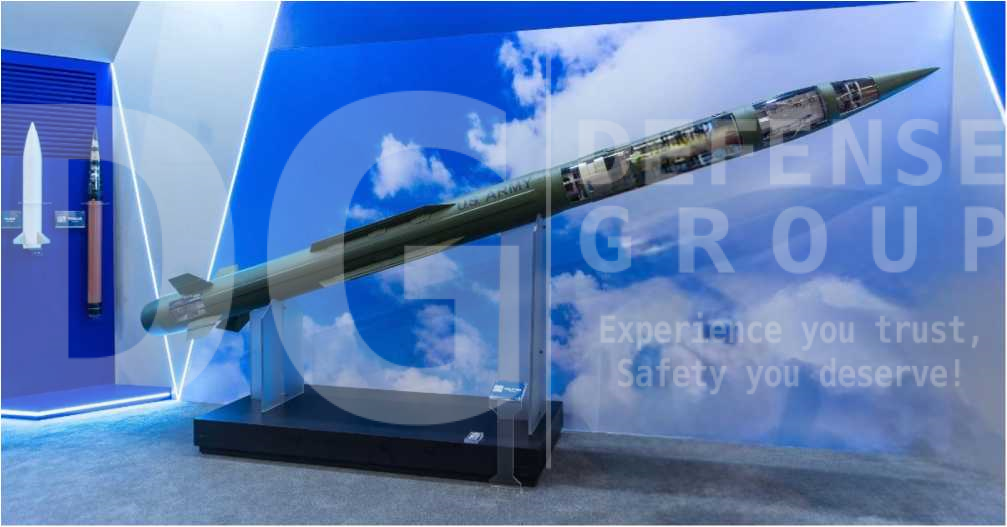
Lockheed Martin presented PAC-3 MSE ACE, a lower-cost interceptor concept developed for an environment in which using high-value missiles against large numbers of inexpensive aerial threats presents an increasingly difficult cost equation. The ACE is intended to cost roughly half as much as the PAC-3 MSE, whose unit price is estimated at around $4 million. At the same time, MBDA presented a concept for a new interceptor intended to counter drones and other low-cost threats.
This is more than a technological trend. It reflects a fundamental reassessment of the economics of warfare. When an adversary can deploy dozens or hundreds of relatively inexpensive airborne targets, an air-defence architecture must be capable of responding not only effectively, but economically.
Farnborough 2026 made one point particularly clear: the next stage of air-defence development is not solely about range and accuracy. It is also about the ability to absorb and defeat threats at scale. That has particular relevance for Ukraine.
Another shift was equally apparent: the boundaries between aircraft, drones, missiles and sensing systems are becoming increasingly fluid.
One platform can serve as a carrier for another. An unmanned aircraft can operate alongside a fighter. A reconnaissance asset can feed targeting data into a strike chain. An interceptor can become one element of a layered air-defence architecture.
This direction is also reflected in the development of the Global Combat Air Programme (GCAP), where the next-generation fighter is being conceived not as an isolated platform, but as part of a broader combat-air architecture incorporating unmanned systems, advanced sensors and new communications capabilities.
For the defence industry, this changes the definition of the product itself.
Competition is no longer limited to individual platforms. Increasingly, it is about integration, interoperability, weapons, sensors, software and the ability to scale an operational capability rapidly.
The practical question is straightforward: which of the technologies displayed can ultimately be delivered to armed forces not in dozens, but in hundreds or thousands?
A lower-cost interceptor only creates a meaningful capability if it can be manufactured at volume. A loyal wingman requires both an industrial base and compatible weapons. An unmanned platform must be capable of integration into existing command-and-control architectures. A new missile needs a resilient production and supply chain behind it.
For Defense Group, this makes industrial capacity just as important as technical specifications. The solutions that matter most are those that can be integrated quickly and supported throughout their operational lifecycle.
THE DEFENSE GROUP VIEW
For Defense Group, Farnborough provided an opportunity to examine this transformation from the perspective of an international defence supplier — not only assessing emerging technologies, but also looking at the industrial capabilities behind them.
The market is moving toward modular architectures, greater autonomy, lower-cost effectors and larger numbers of interconnected systems.
Our focus is therefore practical: identifying not simply technologically promising products, but manufacturers with the capacity to support serial production, international supply and long-term industrial cooperation.
DEFENCE GROUP
Connecting defence capabilities with the partners who can deliver them.