Paris | 15–19 June 2026
You can go to Eurosatory for the tanks. You can go for drones, air defence, robotics, radars and emerging technologies — more than 2,600 exhibitors filled the exhibition grounds this year. Or you can walk the kilometres of exhibition space looking for something harder to spot: the developments that reveal where the defence market is moving next. That was our approach.
The Defence Group team treated Eurosatory as a route rather than a catalogue — following the technologies, platforms and industrial trends that could have consequences well beyond the exhibition floor.
These are our Field Notes from Paris.
01 — WHAT WE SAW
The first signal from Eurosatory 2026 was unmistakable: conventional military equipment is becoming digital, networked and increasingly autonomous.
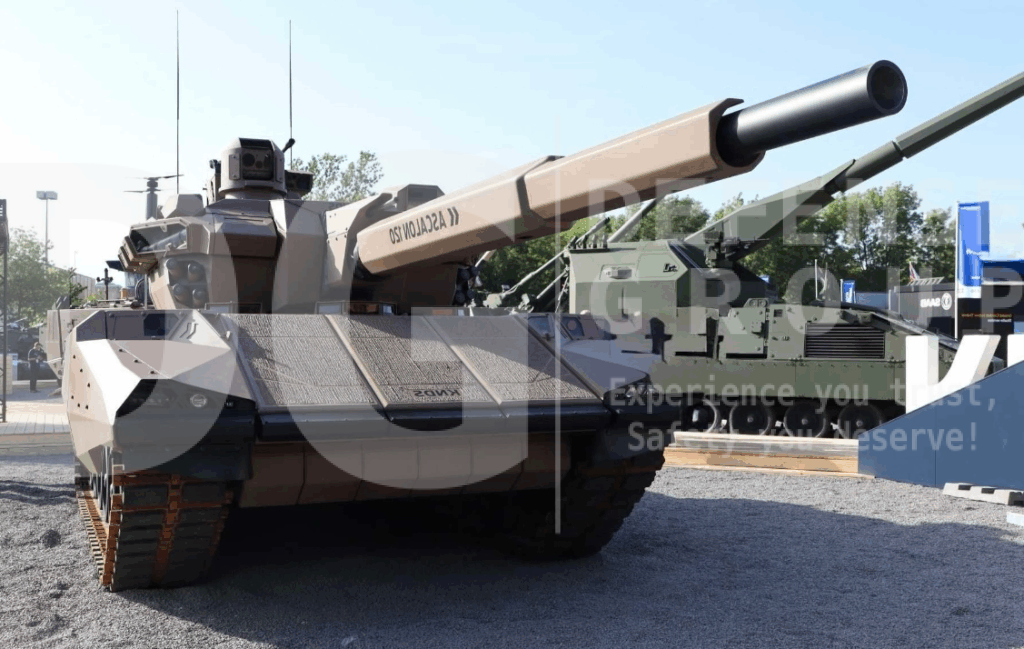
One of the major premieres was the KNDS CAPINT, a new main battle tank concept developed around the realities of today’s battlefield — digital integration, situational awareness and the growing threat from small unmanned systems. It is not a perfect platform. But its development reflects a wider European search for solutions that can be introduced faster.
The next stop: robotics. Across the exhibition, we encountered platforms that until recently would have been regarded primarily as experimental.
At Eurosatory, many had moved into a different category: tangible defence products with defined operational roles. Among them were new unmanned ground vehicles, including a UGV based on the Patria TRACKX platform, fitted with a RENK HSWL 076 transmission.
Another area drawing attention was autonomous reconnaissance and recovery.
GDELS and FFG presented the Piranha Heavy Mission Carrier Advanced Recovery Vehicle — a 10×10 recovery vehicle designed to support the next generation of heavy wheeled combat platforms, including the RCH 155.
Battlefield robotics is not developing solely around strike capabilities. Recovery, logistics, reconnaissance, maintenance and resupply are becoming part of the same transformation.
Then came the capability no modern land platform can ignore: counter-UAS.
Among the notable premieres was the new generation of S-KAPS — Soft-Kill Advanced Protection System, developed by Lacroix, Bertin Technologies and MC2 Technologies. Presented at Eurosatory in its latest configuration, S-KAPS features a more modular architecture and a new computing unit incorporating protection
algorithms. The system is designed to counter small UAVs, including threats capable of attacking armoured vehicles from above.
The wider development is even more significant. Counter-UAS is moving from a specialised niche into the standard protection architecture of combat vehicles.
02 — WHAT MATTERS
The most relevant capabilities on display no longer exist in isolation.
A tank now needs its own sensor architecture and protection against unmanned threats. A UGV operates as part of a network. Counter-UAS combines detection, computing and defeat mechanisms. Reconnaissance drones feed into C4ISR. Air defence is increasingly built around networked architectures.
The competitive advantage is shifting accordingly. It is no longer enough to have a capable product. Its ability to integrate may be just as important.
For Defence Group, this has direct implications when evaluating technologies, manufacturers and potential international partners.
03 — WHAT CHANGES
Ukraine was one of the strongest signals in Paris. The Defence Group team spent significant time across the Ukrainian exhibition area. More than 80 Ukrainian companies presented their capabilities at Eurosatory 2026, covering unmanned systems, electronic warfare, ground robotics, missile technologies, ammunition, reconnaissance and electronics.
But the importance of the Ukrainian presence went beyond the number of exhibitors. It demonstrated what happens when defence development is exposed to continuous operational feedback.
Flamingo: one of the most notable Ukrainian premieres. One of our stops was the Fire Point stand. The company appeared at Eurosatory independently for the first time, with the FP-5 Flamingo emerging as one of the most prominent Ukrainian developments at the show. The publicly presented specifications include a range of up to 3,000 km, a speed of up to 950 km/h and a warhead of approximately 1,150 kg.
The specification sheet was only part of the story. What stood out was the pace at which Ukraine’s defence industry has evolved — and the extent to which operational experience is feeding directly into development.
Flamingo also illustrated a broader shift: Ukrainian defence technology is increasingly becoming part of European industrial cooperation.
On 16 June, Fire Point and German company HENSOLDT signed a memorandum of understanding within the FREYJA project, a future pan-European missile-defence initiative. Germany is expected to contribute its TRML-4D radar technology.
This is an example of defence cooperation moving beyond the acquisition of a finished product towards the integration of national technologies within a multinational programme.
Ukraine therefore brought more to Paris than individual flagship systems. It brought development speed.
Across the exhibition, we saw capabilities that only a few years ago would have been regarded as prototypes and that are now backed by operational experience. That creates a distinctive proposition for international partners.
04 — WHAT COMES NEXT
From product demonstration to industrial cooperation
This is where Defence Group sees significant potential for international partnerships:
- Ukrainian technology + European production. Ukrainian developers bring combat experience, rapid iteration and direct operational feedback. European partners can contribute established manufacturing capacity, capital, industrial infrastructure and access to major defence programmes. Bringing these capabilities together could shorten development cycles and accelerate the transition from technology to scalable production.
- Counter-UAS. Demand for protection against unmanned threats continues to expand. The opportunity is increasingly moving beyond individual anti-drone solutions towards integrated architectures combining sensors, processing, electronic warfare and other defeat mechanisms.
- Autonomous ground systems. Robotic platforms are moving steadily beyond the experimental phase. Reconnaissance, logistics, recovery, maintenance and resupply are among the areas where autonomous capabilities could become increasingly relevant.
- Components. Engines, radars, electronics, navigation, optics, communications and other critical subsystems are becoming strategically important elements of the defence supply chain. This is why international cooperation increasingly begins not with a complete combat vehicle, but with a technological component that can become part of a larger capability.
THE DEFENCE GROUP VIEW
Eurosatory reinforced a trend that is becoming increasingly difficult to ignore: modern defence is becoming system-based.
A tank no longer exists independently of the drone. The drone depends on sensors. Sensors feed command-and-control architectures. And manufacturers themselves increasingly operate within international industrial and supply networks.
The Ukrainian presence highlighted another side of this transformation: how direct combat experience can accelerate the development, testing and refinement of defence technology.
For Defence Group, this is where the practical opportunity lies. Not simply in finding another product. But in identifying the technology, manufacturer and international partner capable of turning that technology into a scalable defence capability. That is what we were looking for in Paris. And that is what we brought back from Eurosatory 2026.
DEFENCE GROUP
Connecting defence capabilities with the partners who can deliver them.