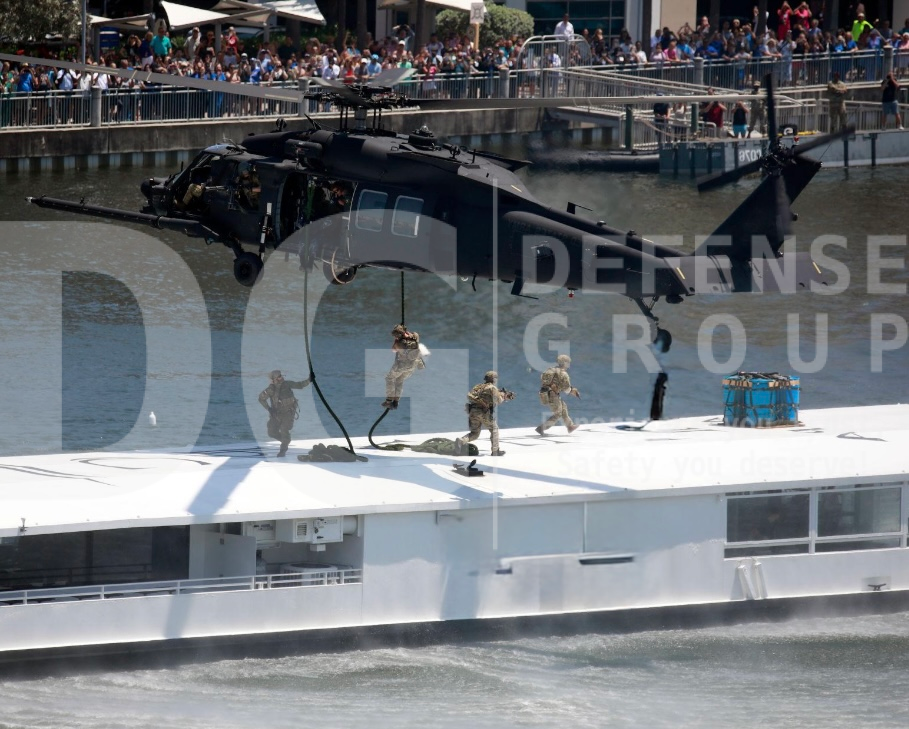
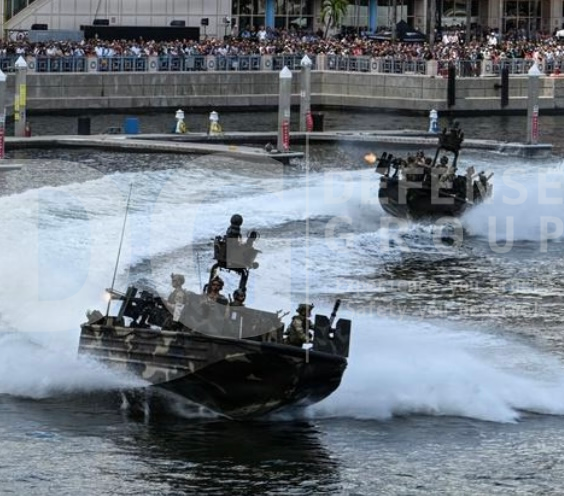
Tampa, Florida, USA | 18–21 May 2026 Tampa Bay became a testing ground for the future of special operations. From the Tampa Convention Center and the city’s waterfront to Peter O. Knight Airport, the Defense Group team worked non-stop, tracking the technologies and operational priorities shaping the next generation of special operations. Around us were leading defence manufacturers, experienced operators and military delegations from across the world.
The scale of SOF Week 2026 was equally striking. At the active airport, the Autonomous Systems Showcase took unmanned technologies beyond exhibition stands and into the air, where systems could be demonstrated in a live environment.
This year, the U.S. Special Operations Command and the Global SOF Foundation brought together more than 20,000 participants from over 75 partner nations. On 20 May, the event culminated in a large-scale joint demonstration involving USSOCOM and special operations forces from ten allied countries in Tampa Bay
The real value of SOF Week lies in its lack of artificial boundaries. The entire event is built around operational requirements — the real-world demands that special operations forces identify for future missions. Defense Group found itself in an environment where the distance between an operator’s combat experience, engineering expertise and practical implementation was reduced almost to zero.
Our Field Notes from Florida.
01 — WHAT WE SAW
SOF Week 2026 made one shift particularly clear: loitering munitions and launched effects are moving rapidly from emerging concepts into practical tools for special operations.
Among the new systems was Rogue 1 Block 2 from Teledyne FLIR, unveiled at the event for the first time. The upgraded strike drone extends its range beyond 20 km — more than twice that of the previous version. Rogue 1 is also linked to the U.S.
LASSO (Low Altitude Stalking and Strike Ordnance) programme, underlining its focus on special operations requirements.
Another notable system was K4 MANTA, an unmanned surface and subsurface platform being developed by USSOCOM together with the UK-based Kraken Technology Group. Following an OTA agreement signed in 2025, the system is being adapted to specific special operations requirements. Its open architecture allows different sensors and technologies to be integrated according to the mission.
A further strong theme at SOF Week was RF sensing and counter-UAS. CRFS presented the RFeye Ranger, Aerial Monitoring System and Signal Discovery solutions for detecting and analysing signals associated with unmanned systems.
Hidden Level demonstrated passive RF sensing capable of feeding data directly into multiple C2 platforms, including TAK.
Taken together, these developments point to an increasingly important sequence in modern special operations: detect — identify — share the data — act.
At SOF Week, these elements were no longer presented as isolated technology categories. They were increasingly visible as components of a single operational chain.
02 — WHAT MATTERS
The Outpost at Peter O. Knight Airport was one of the most revealing elements of SOF Week 2026. Organisers moved part of the technology demonstration beyond the exhibition halls to the airfield, where autonomous systems, aviation technologies, ISR, EW, communications and multi-domain solutions were presented in live, operationally relevant scenarios.
For these systems, that distinction matters.
An unmanned platform, autonomous system or C-UAS solution cannot be fully assessed from specifications displayed on an exhibition stand. At The Outpost, visitors could see how systems performed in a real environment and how close they were to practical operational use.
In effect, the event brought together three stages that the defence industry often treats separately: R&D, demonstration and testing.
03 — WHAT CHANGES
SOF Week also highlighted what happens after a technology has demonstrated its potential — and how quickly it can move from an identified requirement towards procurement.
USSOCOM is focused on shortening this cycle. According to SOFWERX, its relevant mechanisms have already supported $503 million in contracting across 1,824 purchase orders. At the same time, Phase I has been reduced from 102 to 36 days, while Phase II has been cut from 105 to 28 days.
This means that speed is no longer measured only by how quickly a product can be developed. The ability to validate a solution, adapt it to the customer’s requirements, move through procurement and transition into production is becoming equally important.
04 — WHAT COMES NEXT
Special operations are becoming one of the most demanding environments for defence technologies. A promising product is not enough. It must withstand testing, integrate with existing infrastructure and have a production base capable of supporting further scale-up.
This is also changing the way defence procurement is approached. Customers increasingly look beyond a catalogue of specifications towards the ability to obtain a required capability quickly and continue developing it alongside the technology.
For manufacturers, this means a shorter route from R&D to fielding, together with the ability to work directly against real operational requirements.
For us, as an international supplier, the criteria for selecting technologies and manufacturers are becoming more demanding.
THE DEFENSE GROUP VIEW
At SOF Week 2026, together with our partners and colleagues, we analysed where demand is heading.
For Defense Group, events of this kind have a clear practical purpose. We identify new manufacturers and suppliers, assess their products and production capabilities, compare technologies and determine which solutions can be offered to our international partners and customers.
That is where our core work begins: matching products to specific requirements, arranging supply, overseeing production and quality, managing logistics and supporting international defence contracts. SOF Week is therefore not a collection of business cards or a catalogue of new products. It is where we find what is needed.
DEFENCE GROUP
Connecting defence capabilities with the partners who can deliver them.