São Paulo | 14–16 April 2026 Military equipment alongside policing systems. Countering organised crime coupled with AI. Border protection together with cybersecurity for critical infrastructure. This is the intersection where LAAD Security Milipol Brazil operates.
In 2026, the exhibition brought together more than 120 companies from over 20 countries, offering a distinctive view of the Latin American defence and security market. Here, technologies are assessed not only by their combat performance, but also by their ability to address specific security requirements — from territorial control and counter-narcotics operations to urban security and critical infrastructure protection.
For Defense Group, it was an opportunity to examine what this market is ready to adopt — and how its specific requirements are shaping the development of new technologies.
Our Field Notes from São Paulo.
01 — WHAT WE SAW
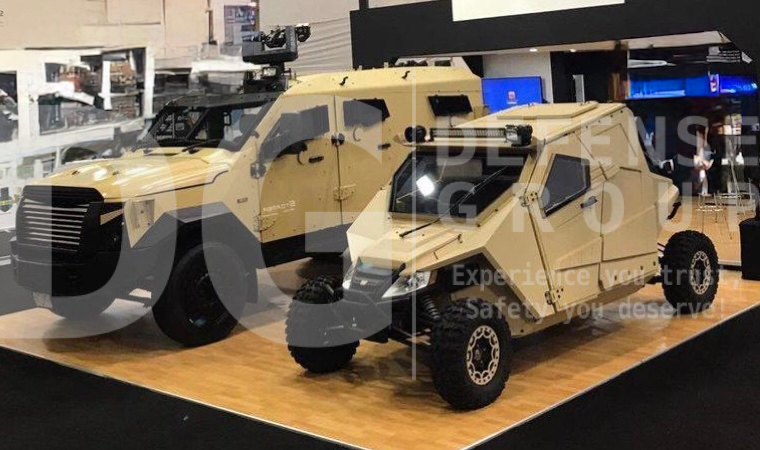
Our first stop was IBEX. At LAAD 2026, Plasan Re’em and Brazilian company ACTATEC presented a light armoured vehicle based on the Toyota Hilux, developed for police operations. Ballistic protection up to STANAG Level 2, a modular architecture and adaptation for high-risk missions — combined with a clear focus on the Brazilian market.
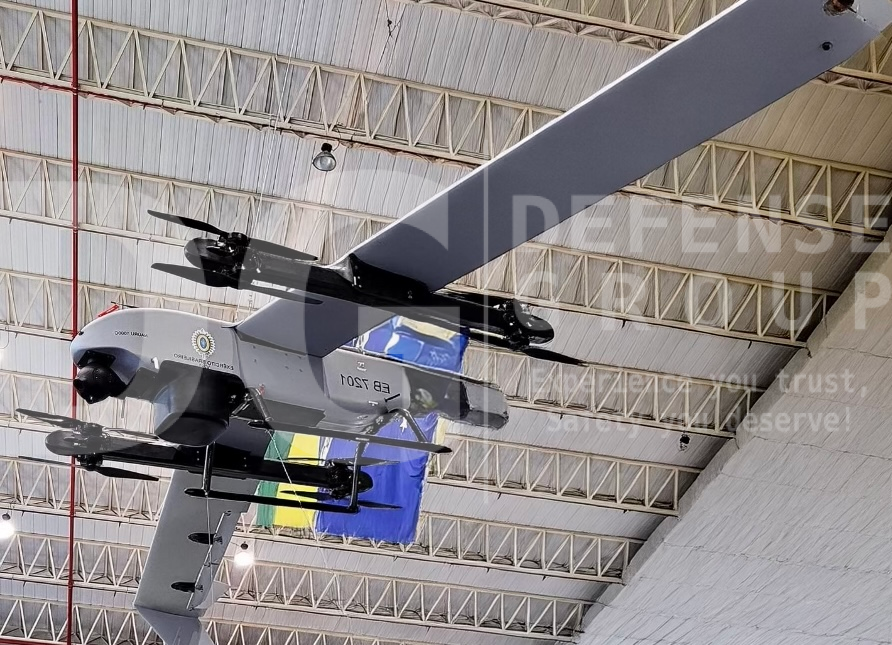
A few stands away, XMobots’ NAURI 1000 C drew attention. This time, it was not only the UAV itself, but the configuration on display: 120 mm mortar ammunition was presented beneath the aircraft. The UAV was shown as part of a broader operational capability rather than as a standalone platform.
Autonomous systems then moved from the air to the water.
SUPPRESSOR, developed by EMGEPRON and TideWise, is an unmanned surface vessel approximately 11.5 metres long. It can operate remotely or autonomously for surveillance, reconnaissance, maritime area monitoring and mine- countermeasure missions. The platform has already undergone trials during Brazilian Navy exercises.
And then came another shift — into the digital domain.
At LAAD, Indra launched IndraMind in Brazil, an initiative combining AI, cybersecurity and cyber defence for security, critical infrastructure and border-control applications.
02 — WHAT MATTERS
One of the key developments was the memorandum signed on 16 April by EDGE and Indra. The companies agreed to jointly explore, develop and manufacture next- generation radar systems in Brazil, with the participation of SIATT.
Indra’s technological expertise, SIATT’s engineering and manufacturing capabilities, and EDGE’s international industrial platform bring three distinct areas of competence into a single industrial programme.
EDGE also signed a separate memorandum with the Brazilian Navy, focused on cooperation in cybersecurity for maritime systems and operational technologies.
For Defense Group, the significance lies not in the signatures themselves. These agreements illustrate how international defence companies are establishing long-term positions in the Brazilian market — through technology, local industrial partners and joint development programmes.
03 — WHAT CHANGES
IBEX brings an international technology adapted together with a Brazilian partner.
EDGE + Indra + SIATT demonstrate a model for future radar cooperation and local production in Brazil. EDGE + Brazilian Navy represent a separate track of long-term alliance in cyber defence.
These cases are different, but together they point to a broader shift: Latin America is becoming more than a destination for defence products. It is becoming an environment for technological and industrial partnerships.
That changes the way international defence companies need to approach the region.
04 — WHAT COMES NEXT
The next step for us is to test the signals from the exhibition against operational and industrial reality.
Defense Group is moving from observation to work on specific areas: identifying who is already producing, which technologies are ready to scale, where local engineering capacity exists and where international expertise is required.
Our focus is on solutions that can move beyond the exhibition floor and become part of real procurement programmes and capability-development efforts: unmanned and autonomous systems, counter-UAS, radars, surveillance technologies, AI and cyber defence.
The next stage is the selection of specific companies and technologies, technical assessment, verification of manufacturing capabilities and moving towards substantive business dialogue.
THE DEFENSE GROUP VIEW
Latin America is looking beyond finished systems, with growing interest in technologies that can be adapted to local requirements, manufactured locally and integrated into long-term projects.
That is changing the architecture of the defence business in the region.
For international companies, bringing a finished solution to an exhibition, demonstrating it and waiting for an order is no longer enough. Increasingly, value is
created where technology, local expertise, manufacturing capability and access to international supply chains meet.
This is the shift we will continue to follow — not simply where the market is moving, but who is building it.
DEFENCE GROUP
Connecting defence capabilities with the partners who can deliver them.