A drone that detects another drone. An interceptor that hunts it down. AI that predicts its trajectory. Networks that connect sensors, operators and effectors.
Production lines designed to deliver tens of thousands of systems.
This is no longer a glimpse of where unmanned warfare might be heading. At XPONENTIAL Europe 2026, it was already visible across the technology and industrial landscape.
The shift is fundamental: the drone is no longer an individual platform. It is becoming part of a wider combat architecture — combining sensing, data, AI, communications, autonomy and interception.
European industry is now building the capacity to scale these technologies.
Ukraine is testing many of the underlying concepts under real combat conditions — against electronic warfare, rapidly changing tactics and an adversary that adapts continuously.
In Düsseldorf, these two trajectories were increasingly visible in the same place: combat-driven lessons from Ukraine meeting Europe’s industrial, technological and production capabilities.
Here are our Field Notes.
01 — WHAT WE SAW
OSIRIS UEB-1 — a Ukrainian-developed system publicly presented for the first time at XPONENTIAL Europe 2026. Its role is to intercept airborne targets. Its stated maximum speed is up to 315 km/h, with a range of up to 18 km, while its AI-based system is designed to predict the target’s trajectory.
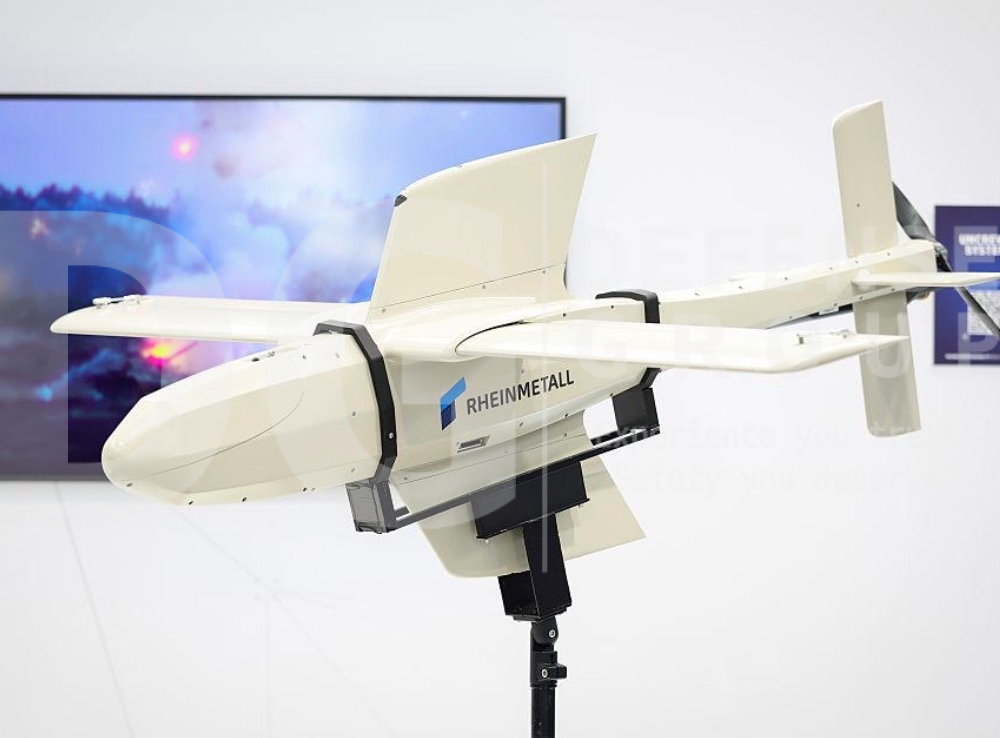
At the Rheinmetall stand, the FV-014 attracted attention as a new loitering munition concept. It combines reconnaissance and strike functions: the system can first detect and assess a target before transitioning to engagement.
Then there was the RV-005, a dedicated C-UAS interceptor designed to physically defeat small UAVs. The system uses AI to support precise approach to the target even in the presence of electronic interference and can be integrated into a broader counter-UAS command-and-control architecture.
Another significant demonstration was the BVLOS flight activity over the Rhine.
During the exhibition, drones conducted such operations over Düsseldorf, using the Theodor Heuss Bridge as a real-world environment for infrastructure inspection.
02 — WHAT MATTERS
One of the most significant developments at XPONENTIAL was the signing of a joint memorandum by 25 European companies representing different segments of the drone and drone-defence value chain. Their shared objective is to establish
production capacity exceeding 100,000 drones and counter-drone systems per year by 2027.
The discussion went beyond individual platforms. Participants focused on scaling production, building resilient European supply chains, strengthening technological sovereignty and reducing dependence on external suppliers for critical components — including processors, power electronics, antennas, data links and sensors.
Another recurring issue was the need for predictable government procurement as a prerequisite for maintaining stable production capacity.
For Defense Group, this was one of the clearest signals from the exhibition.
Europe’s drone industry is no longer speaking primarily in terms of individual developments. It is moving toward the language of industrial capacity.
03 — WHAT CHANGES
Ukraine is becoming a critical environment for the rigorous validation and operational testing of unmanned technologies. Drones are being deployed at a scale that peacetime markets do not replicate. They operate under constant electronic warfare pressure, face rapidly changing tactics, undergo accelerated upgrade cycles and must remain effective as the adversary adapts.
That is why Ukrainian combat experience is becoming increasingly difficult to separate from Europe’s discussion about the future of autonomous warfare.
At XPONENTIAL, this was visible across three key areas.
First — autonomy. A system must be capable of performing more functions while the operator retains control over critical decisions.
Second — mass deployment. A technology must be affordable and scalable enough to operate not in dozens, but in thousands of systems.
Third — integration. A drone is no longer sufficient on its own. It has to become part of a network in which sensors, AI, communications, command systems and strike or interception capabilities work together.
This is the logic now taking shape around counter-UAS and autonomous systems in Europe. Ukrainian battlefield experience is accelerating the process.
For Defense Group, this changes the way technologies need to be assessed. The key question is no longer only what a system can do today, but whether it can remain effective in an environment where the adversary is constantly changing the rules.
04 — WHAT COMES NEXT
Defense Group will continue to monitor technologies that extend beyond individual platforms: AI and mission systems, counter-UAS, sensors, resilient communications, critical components, and ground and airborne robotic systems.
Particular attention will be given to technologies that can be integrated, rapidly adapted and manufactured at scale.
The next phase of drone warfare will not be determined simply by who develops the most advanced prototype. It will be determined by who can produce, upgrade and deploy thousands of systems faster than the adversary can adapt to them.
THE DEFENSE GROUP VIEW
Our observations made one thing clear: the drone is no longer the system. The system is the network around it.
Sensors, AI, communications, autonomy, operators, command systems, interceptors and production capacity are becoming parts of the same operational equation. Ukraine is already operating inside this reality. European industry is now building the capacity to scale it.
For the international defence industry, this changes the speed of the game.
Technology cycles are shortening. Adaptation is becoming continuous. And production capacity is becoming as important as the performance of the platform itself.
The next advantage will not belong simply to those who develop the most sophisticated system. It will belong to those who can produce it, adapt it and put it into the field — at scale, and fast enough to stay ahead of the next change.
DEFENCE GROUP
Connecting defence capabilities with the partners who can deliver them.